Power Quality Optimization with Active Harmonic Filter :
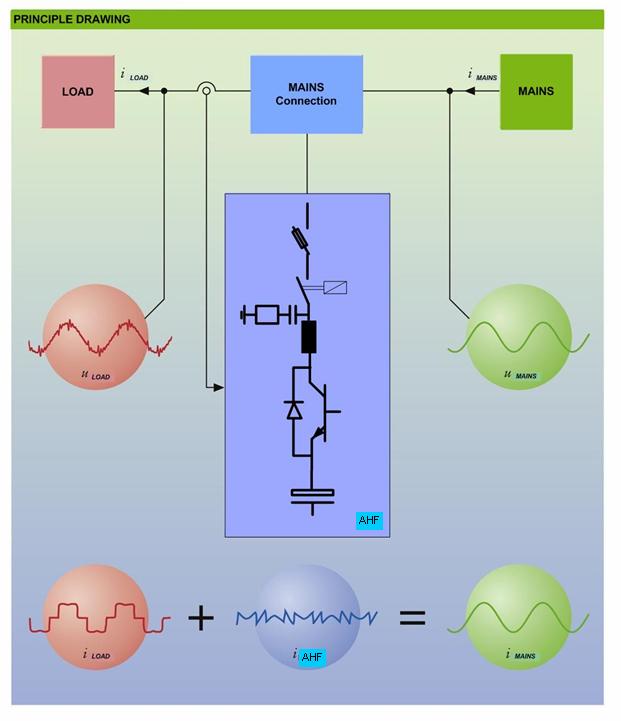 It is widely believed that active harmonics filters (AHF) are very costly and, therefore, are the last choice for power quality solutions. The answer is it depends. Every harmonics mitigation and power factor correction device has its place in the market.
Knowing what a solution does for power quality and the advantages and disadvantages of each solution provide optimized solutions with maximum benefits for the user.
Active harmonics filters provide controlled current injection to remove harmonic current from the source side of electrical system s and reactive current to correct for poor displacement power factor (PF). Active harmonics filters can be applied to a single nonlinear load or many. The nonlinear loads can be mixed types or devices, such as variable frequency drives (VFD), DC motor speed controls (aka DC drives), uninterruptible power supplies (UPS), or thyristor (DC) power supplies, to name a few.
When is the best value achieved with active harmonic filters?
- When more than one nonlinear load and/or type of loads are present : DC drives, UPS, VFD, and others can operate on the same electrical system as an active harmonics filter system
- When input line reactors are used to reduce the total harmonics distortion of nonlinear loads.
- When 6-pulse rectifiers are employed in DC drives, UPS, VFD or DC power supplies.
- When thyristor rectifiers are used and power factor and harmonics correction are required : DC drives and DC power supplies require power factor correction and harmonic mitigation.
- When PF correction is required where high harmonics content is present : Poor power factor in an electrical system a high content of nonlinear loads cannot be performed by traditional power factor correction capacitor systems
- Where rapid in-rush or step load changes require support (aka VAR compensation) to stop flicker : The power quality of an electrical system is quite poor due to the massive voltage variations caused by the loads.
- When meeting harmonics specifications within your facility.
The nature of harmonic currents is that they are vector sums of the amplitudes, current and voltage, at each harmonic order. That is they are the root sum square of each harmonic order times the cosine of the phase angle differences between the vectors. Vector math makes 1+1 = Sqrt 2 (1.414) not 2. Active harmonic filter selection uses this to actually reduce the per amp size of the active filter as the quantity of nonlinear loads increases. Individual solutions (that is per rectifier) must be sized for the full amplitude harmonic spectrum making them, collectively, more expensive and physically larger than AHF
6-pulse rectifiers produce the highest level of harmonic current among three phase loads. If no impedance is present as an input line reactor or a DC bus choke (for diode rectifiers only), 6-p rectifiers may approach 100-120% total harmonic current distortion (TDD). A first step to reduce this very high level of TDD is to insert 3-5 % impedance line reactance to reduce the TDD to about 32-40% per rectifier. Then the AHF is selected for this much lower TDD level. Thus the AHF size is reduced due to the inexpensive insertion of inductors.
Thyristor rectifiers are known as phase controlled rectifiers. Thyristors are turned on at varying points in the AC waveform to control the power delivered to the DC side of the rectifier. This process causes displacement PF variations and harmonics. The interesting point is that maximum harmonics occur at best displacement PF and vice versa. The AHF is the best device to provide exactly what is required to achieve best total or true PF – highest lagging PF and lowest TDD – all the time. This achieves high levels of power quality.
It is always difficult to select tuned PF capacitor systems when the harmonics content is high. The tuning tends to be difficult due to the amplitude of harmonic current that flows through the capacitor circuit. The solution is to make the PF capacitor VARs larger so as not to over load the capacitors. This may preserve the capacitors but can cause leading PF at times. AHF will not cause leading PF at any time and don’t care if harmonics are present while performing PF correction.
Loads that cause flicker (light intensity variations due to rapid line voltage variations) are very short duration events – sometimes as short as 2-3 cycles. AHF are fast enough to provide support in about 100 microseconds. Often the AHF can be packaged with PF capacitor stages to create a hybrid VAR compensation (HVC) system for price and physical size optimization.
When applying harmonics standards inside a facility, the solution is sometimes difficult to attain. This is usually due to the low short circuit current capacity of the point of common coupling chosen within the plant. AHF make meeting or exceeding the standard simple, effective, and complete.
Does the above help you understand AHF and power quality?
What can we do to help you further?
Jim Johnson
will kvar effects generation & transmission
Uitlity systems have the ability to provide KW (voltage and current in phase), KVAR (voltage and current out of phase), and harmonic current (current at integer multiples of the base frequency). VAR and harmonic current are conducted in the power cables.
VAR current proportionally reduces the ability of the grid to provide real current (KW).
Harmonic current causes heating disproportionate to its amplitude. Heating effect is much larger than actual current amplitude.
When loads demand either VAR or harmonic current, the grid capacity is reduced. Therefore, the grid conductors must be oversized where this occurs. The solution to prevent over utilization or oversizing of the grid due to VAR and harmonic current is to provide the source of each locally and remove the demand from the grid – PF correction and harmonic filters.
From the generation side, when rotating generators are used to produce the power, the generator has the ability to provide VAR support readily. It is the electrical nature of the generator. Generators do not like to produce harmonic current – extra heating occurs – but can.
However, as we move to more and more alternative methods of power generation, the electronics used to create the power (from PV or wind or etc.) only produce KW. Thus a need of alternate KVAR and harmonic support is required. This can be local by the user or universal by the utility. The cost must be born by the user in all cases.
From an energy efficiency stand point, local support for both KVAR and harmonic current reduces the cost of transmission (size of cables and alternate sources) and utilization of the grid. It permits more KW to be transmitted on the existing cables and permits planning of future grids to include smaller cables = less mineral resources consumed and processed. It helps make the planet greener.
I have read your comments on Harmonic Fillters. I am really impressed on your knowledge about power conditioning.We are facing one problem regarding harmonics. We have various ratings of induction motors at our water pumping stations in NASIK, INDIA. The motors are 440V ratings from 3HP to 300HP at almost all sites. At 2 sites, we have 3.3KV 430HP and 1000HP motors. We are using conventional DOL , Star delta and Auto transformer starters. The Electricity board has sent us notice that at some sites, near the metering point , the supply checked is distorted and THD found from 10 to 25%. We are not using any types of drives, we do not have UPS, Inverter, Rectifiers or any type of electronic switching devices. How can harmonics be created by our load? Is it possible? We are maintaining power factor unity at all our sites. Is it possible that at some point if power factor goes leading, harmonics are generated? Will leading power factor create harmonics? Is it possible that harmonics are entering from electricity board line? Please explain current / voltage harmonics.
HI, Umesh,
When there an no nonlinear loads present and PF capacitors (PFC) are used to raise the displacment PF (DPF) above about 0.95 lagging, the issue is usually resonance.
You indicated the DPF objective is unity. Attempting to maintain above about 0.95 lagging DPF with PFC is often dangerous and results in exactly what you have stated.
PFC are designed to switch slowly. The result is that at times the DPF goes leading. If curcumstances are correct resonance with the utility PFC can occur. One sympton is that the mains voltage rises before the resonance begins.
As a general rule, Schnieder Electric dos not recommend using PFC to correct for DPF above 0.95 lagging. We suggest using an active harmonic filter. Active harmonic filters (AHF) provide DPF correction by injecting phase shifted current electronically. This eliminates the possibility of resonance.
You can use PFC to correct to 0.95 lagging and supplement the rest to unity with AHF.
Please contact your Schneider Electric sales and aplication center in India for assistance.
Thanks for writing and good luck.
Hi Jim,
I have something different to ask you about please. I recently discovered that it is possible to take 3 phases 400 Volts AC 50 hz and with the help of a choke and a capacitor, make it a 3 phase balanced supply to a 2 phase 400 Volts induction furnace. But I know very little about it and wish to understand this better. Can you help? We have 12 furnaces on 2 phases and the power is very unbalanced all the time. The furnaces are being switched by thyristors at present from a PID configured Eurotherm 3204 temperature controller putting out 4 to 20mA to a phase angle card driving a back to back thyristor pack in one leg of the 2 phase supply.
I also wish to understand how switching it with IGBT drivers will work and if it is better, since I have been advised to change the thyristor control to IGBT. Can you help me with advice here also please?
Cobus
This blog is fantastic by johnson and is too technical. I simply love it and I want to ask one thing to Jim, What is exactly the diff. between tuned and de-tuned harmonic filter. Which one is appropriate for VFDs? what is the exact process of connecting the filters with the load? Is there any good quality makes available in the market? Please confirm
Thanks for the compliment. The subject is not simple – it gets tough to make it simple.
A PF capacitor when placed in an electrical system has a resonant frequency based upon the inductance of the electrical system (from any point) and the capacitance of the PF capacitors. The PF capacitors are installed parallel to the loads. Adding a reactor in the parallel portion of the circuit in series with the capacitors modifies the frequency of the PF capacitor bank and thus the resonant frequency of the PF capacitor bank in the electrical system. This is ‘detuning.’
PF capacitors will interact with all frequencies present in the electrical system. When harmonics are present this is harmfull to the capacitors. The harmonic currents will overheat the PF capacitors to shorten its life or trip its thermal safety devices. Detuning can be designed to ‘block’ most of the harmonic currents or can be designed to permit the current of one harmonic frequency to flow into the capacitors. The ‘blocking’ design is considered ‘detuned’ within the industry. The design that permits a harmonic order to flow into the capacitors is called a ‘tuned’ capacitor or a harmonic filter.
Detuned and tuned capacitor systems are typically of two application philosophies. One is an electrical system solution where one large bank is used for a group of loads or used at the utility connection. Local and worldwide suppliers of these exist. However, a harmonic study is required for these types of solutions. Be sure the company chosen can provide this before equipment is purchased.
The second philosophy is to place a small tuned capacitor system at each nonlinear load to provide harmonic suppression for the electrical system. To be sure that these small tuned banks do not interact with each other (when more than one is installed) or overload due the presence of other sources of harmonics, a series reactor on the source side of the filter section is required. The series reactor is sized for the full load current of the nonlinear load on which applied.
The tuned filter also provides leading reactive current that must be evaluated within the system to determine if problems may occur due to excessive leading PF. The manufacturers of these type of filters tend to be localized operations within individual conutries. They exists in many countries.
The result of properly applying either device will relieve the utility of conducting VARs and specific harmonics and permit green generation technologies to be more easily employed.
Regards
Dear Jim,
Really admire your in depth knowledge and expertise in the Power Quality issues. Though there’s some other school of thought which I wish to streamline to avoid confusions as there are other terminologies being utilize.
Could you give us particular commercial available asources of Harmonics Mitigatos and filters.
Thanks and regards,
Orlando
Hi, Orlando,
Thank you for your comments and interest in the subject.
The commercial market has a different concern than does the industrial market. For the most part the industrial market utilizes three phase loads. That is what the previous discussions address.
The commercial market has a mixture of three and single phase loads. Typically, these loads are divided into environment control (HVAC equipment) and office environment. The HVAC equipment of buildings is typically isolated from the office enviornment (supplied by separate electrical distribution systems). The comfort equipment is almost all variable frequency drive (VFD) controlled. VFD provide best efficiencies and best and repeatable controls, but do requir e harmonic mitigation due the high concnetration of VFD.
The office area can be divided into two segments today – lighting and all other equipment. Lighting has been one area where the manufacturers have taken very good steps to reduce their harmonic levels. Generally, electronic ballasts are limited to about 20% TDD (total harmonic current distortion – based upon full load level). Some offer ‘premium’ systems that limit harmonc current content to about 5% TDD. Many governments have issue laws demanding these levels.
All office machines (copiers, printers, desk top PC’s, computer peripherals, etc.) utilize switched mode power supplies (SMPS). The early SMPS were very high in harmonic content but operated at near unity displacement power factor.
Since the mid 2000’s, codes and standards have been issued that require SMPS to be low harmonic devices. The results are that new information technology (IT) equipment comply with about 5% TDD. However, the design of the SMPS is now causing leading displacement power factor at low load levels. This has caused much trouble for the UPS manufacturers since the UPS was not designed to handle this high leading power factor levels. The result is that active harmonic filters have been used to correct for the leading power factor by injecting lagging power factor to permit use on the installed UPS. (Note that newer designs of UPS have addressed this issue so the UPS does operate properly with leading power factor loads.)
All of the above is a preamble for the discussion that I think you asked about – harmonic mitigation for the office environment.
There are several points that are universal. 1) Single phase nonlinear loads create neutral harmonics. (Neutral harmonics are sometimes called zero sequence harmonics or triplen (multiples of 3) harmonics.) 2) Neutral harmonics can exceed the amplitude of the fundamental current – maximum levels are 1.73 (square root of 3) times the fundamental current. 3) Most codes and standards now require the neutral to be sized to twice the size of the fundamental current cables (where one neutral services all three phases) or each phase gets its own 100% rated neutral.
In the 480 V/60Hz world, the 208/120 VAC level is derived from the 480 V supply utilizing isolation transformers with a delta primary and wye secondary. This configuration prevents the neutral harmonics from being conducted on the 480 VAC system.
In the 400 V/50Hz world, the single phase loads are connected from a 400 V phase to neutral and operate at 220 VAC. The result is that the 400 VAC system carriers the triplen harmonics.
The emphasis in the 480 V world is to prevent overheating of the neutral and the transformer providing the supply voltage. Protecting the transformer is easy. Many types of neutral ‘filtering’ exist. They range from blocking reactors that have a very high impedance for the third harmonic, to zig-zag transformers that shunt the triplen harmonics into the mains, to tuned third order passive filters, and ultimately active harmonic filters that treat the triplen harmonics. The issue in all of these solutions is that the electrical system upstream from the filter lconnection will have reduced harmonic current, but nothing has been done for the load side of the harmonic solution. The neutrals still carry the harmonic currents that the nonlinear loads need to operate.
The 400 V world has a very different issue. Besides the neutral discussion which are the same, the 400 V system (which can feed many users) total harmonics include the triplens. So, the TDD levels are higher and more dangerous. Surprisingly, the same solutions are used.
I hope this is helpful.
Regards, Jim
Prezado Jim
eu sou engenheiro eletrico e trabalho com manutenção predial,UPS, cabling e data centers.
eu moro em Brasilia DC Brazil e presencio no dia a dia tudo o que Vc relatou no texto acima.
SEUS COMENTÁRIOS SÃO ÓTIMOS.
poucos profissionais entendem de harmonicas, a literatura é superficial ou muito academica.
os filtros ativos são a melhor solução no meu ponto de vista, mas no Brazil são muito caros.
as harmonicas são um problema mundial e a situação só tende a piorar com o acesso a computadores e todos equipamentos eletronicos presentes nos lares, escritorios e industrias.
temos uma invasão de produtos chineses com fontes com FDP perto de 1 ou capacitivos e com alta THI.
meu principal cliente é o GOVERNO FEDERAL e o menor preço é fundamental, acima da qualidade.
temos predios com energia trifásica 380/220 Volts , porem com cargas predominantemente monofasicas com harmonicas de sequencia zero.
os computadores são ligados comumentemente em 120 Vac ( F,N,T); em alguns casos utilizam transformadores isoladores K-20 delta- estrela.
cuidam do primario e esquecem da fonte das harmonicas
Jim,
In my Energy management business I find that harmonics is popping up all over for my industrial and big commercial clients.
I see the benefit of AHF and understand it is quite expensive. At present my feeling is that it is best to make each piece of equipment or lighting circuit as clean as possible because then it seems to me a shopping mall owner can expect his tenants to not contribute any harmonics to the reticulation of the mall.
My question is where can I find someone who has the designs available for both kind of harmonics filtering AFH and LCL or whatever other design is feasable?
My 2nd question is, whether it may be possible to divert the harmonics energy into a resonant frequency tuned circuit, and tap it off for other uses such as resistive heating etc?
I am in Johannesburg RSA and is looking for a filter designer.
Hi, Cobus,
The reason harmonics are a topic is because semiconductor technlogy is being used for energy savings in all types of applications. New washng machines employ a variable frequency drive and digital logic. They have eliminated the mechanical gear box for a direct coupled motor. It is more efficient. Also, all electronic products employ AC to DC rectifiers. Switched mode power supplies (SMPS) are everywhere. As time passes more of these nonlinear loads will employ their own harmonic mitigation methods. But design evolution takes time.
In the mean time, solutions are offered in many varities. Depending upon the type of loads and the concentration of those loads on any given network the solutions vary widely. I am not familiar with the South African market, so I don’t know who might be able to help you. Shaun Wilson at shaun.wilson@za.schneider-electric.com is one contact I do know who may be able to assist.
Harmonics is called ‘imaginary’ or reactive current in electrical engineering. It does not do work but permits work to be done. This is the same definition applied to reactive current that is phase shifted from the fundamental current (Cos phi). There is no known way to capture this power and reuse it for real work.
Regards, Jim
Jim,
I have questions for you regarding the selection and design of harmonics filters. If I have a 400/440 Volt 3 phase 40kVar capacitor bank in a Powerfactor system which needs to be protected against 3rd to 13th harmonics of various amplitudes, how do I choose the inductance or Xl for each leg of the 3 phase supply to the capacitor? My concern is resonance at some of the harmonic frequencies obviously, as well as the internal heat in the inductor/filter and the voltage drop accross the inductor at the base frequency of 50Hz, because that will reduce the capacitors effective kVar slightly.
Then I also wish to know if I can use tuned filters for each harmonic in a smaller inductor/filter design inside the various machines where the harmonics are being generated and if it is a good idea, what must I bear in mind, or do I rather block the harmonics in a machine with a local inductor/filter designed for the machine and what about voltage drop and heat?
Regards
Hi Cobus,
You would porpably need to connect your caps in delta. This decuple the caps from the triplens.
As for the reactor , you need to select a tunning order where the cap/reactor will provide lowest impedance at that order. for instance we tune our filter to 3.7 order. This order will not interfer with utility ripple signal and will decuple the caps from anything higher than 5th order. This will only work when voltage distortion is around 7%. Above that you need to mannage the harmonics via a tuned filter .usually around 5-7 order thus removing almost 80% of the harmonics in the system. The issue with this type of filter is you need to make sure the filter can abosrb all harmonic currents without overloading the caps. The cap will only take 130% of its rated current before it starts to e fail,hence you may need to address the amount of harmonic current in the netwrok then size a filter accordingly. The kvar value of the all the filters will contribute to reactive compenstaion . This is very cruical in defining the correct way to control the filter. The easiest option is to install an Active filter at the main LV borad and allow it to run in PF/ harmonic mode. you hit 2 birds in one stone and you donot have to worry about resonance.
Jim
Is there a much better rectifier system for plating plants other than SCR control, which will have zero or very little harmonic distortion contribution to the system?
Cobus
Hi, Corbus,
Sorry for the late reply. Got a little busy and failed to go back to my notice from the blog.
The thyristor rectifier is the most rugged, most dependable, and easiest to control rectifier on the market. It is also the least cost. No one has spent time, that I know of, in developing a different method.
Regards, Jim
i am parmjit from daviet. we are making a major porject. so pleace tell me circuit diagram of Harmonic filter for better power quality.
i am very thank full to you.
i am suyog from bhopal i am preparing a major porject. so please tell me circuit diagram of Harmonic filter for better power quality.
the paper is excellent but i want full information about the topic .can u give me please??????
my email id is anil05.perala@gmail.com
hello..i’m admired your knowledge in power quality problem..i’m doing my project to eliminate the harmonic,but still in progress since the circuit is not well design.may i know how to design a simulation of single phase active power filter that use IGBT as an inverter, and how to control the IGBT,I’ve inject pulse generator to control IGBT but it’s still not succeed.my simulation run using matlab/simulink.will you help me to solve this problem?i really need your attention..this my email nadya_mon87@yahoo.com
I have consulted our engineering staff regarding your question. The advise that a masters degree or PhD could provide the knowledge required to fulfill your question. That plus on the job learning has permitted them to know the answers.
However, the process cannot simply be made via this medium….Sorry
Hi Jim Johnson,
I went thought you paper. It is very nice to study about the harmonies as i am new to this field, I need some clarification. What type a harmonies filters can be used in Air condition and what amount of power will be saved in the process. We have like 5000 Air condition in different place. Pls let me konw more about it.
Thanking you
Prem,
I do not believe you actually have harmonic problems because of air conditioners. Normally they are either on or off and pure inductive load. If you have phase angle control on heating elements somewhere, then you will have harmonics. You should consider installing a Power Quality Monitoring Meter permanently which you can download and see whether you may receive harmonics from the grid or generate harmonics and the user trends, balancing of phases etc.if you are serious about improvement.
Regards
Cobus
Hi Cobus
We are interested in harmonic filters for BSNL electro-Mechanical equipments. Can you pls let me know weather power saving will be there if we design hormonic filters for each site.
Thanking you
M. Prem kishore
HI, Prem,
Air conditioners (A/C) can be purely AC motor loads (direct connected to AC lines) or could be driven via AC motor drives (PWM VFD).
If the A/C are AC motor driven there can not be any harmonic content developed. The problem could be reactive current (phase shifted current from the AC voltage waveform).
If the A/C are driven by PWM VFD then harmonic current will be present. The amount will vary based upon the mount of impedance installed in the VFD DC bus (aka DC choke) or 3-phase inductors (aka line reactors) on the input to the VFD. If no inductance is present the THDi at full load (worst case for harmonic content) will be 90-120% per VFD. Using a 3% impedance rated inductor in the DC bus or on the AC lines will reduce the THDi to the 32-40% range.
As far as energy savings goes it is only the I-squared-R (I2R) losses that are saved. That is the power loss due to the conductor resistance characteristics.
For reactive current due to inductive loads, the current reduction is proportional to the reactive current reduction. So, placing PF caps at the AC motors that are line connected will reduce the current and save the I2R. For every ampere of reduction there is a 3 times savings at the power plant that uses coal generation techniques. Locally, the reductions are at best 1-2%.
Also, the utility may enhance the monetary savings for users by charging for poor power factor. This power penalty will no longer be charged if local PF correction is employed. This is usually a much, much higher monetrary value than the I2R losses savings.
As far as harmonic current reduction, the I2R losses are minimal. The rms current due to harmonics is a function of [Ifund x sqrt(1 + THDi squared)]. So, the I2R savings are much less than reactive current correction for poor power factor. A one ampere reduction in harmonic current yield less than 1 amp benefit on the AC lines as far as losses are concerned.
Greater savings is achieved due capacity utilization reductions in transformers and power cables. Greater savings is achieved due to reduced THDv caused by nonlinear loads. Reducing THDv reduces the chance of the THDv causing other equipment to fail and thus cause downtime within the plant. Downtime is a major monetary loss.
So, I don’t see an energy savings discussion for THDi reductions. It is the least benefit to discuss. Operational downtime is a much, much larger play.
Regards, Jim
I have a huge confusion regarding a new VFD panel installed at my fertilizer plant since I am a fresh trainee engineer and I have no hands on experience on them. There are two VFDs of Danfoss make and are used to control two unbalanced motors per VFD. My confusion is that if I follow the theory, then any vfd has essentially three parts: the rectificer, the dc line conditioning, the inverter. Now my confusion is that that at the VFD Panel, the input supply (480 V) first enters into an AHF, from the AHF then to the VFD (that controls the frequency within the band, 35 to 60 hz), then into a line reactor and then finally subdivides to feed two motors. Since the rectifier and PWM circuitry are present INSIDE the VFD, why has the local manufacturer is feeding the lines L1, L2, L3 with an AHF BEFORE the VFD ?
Hi, Omar,
Danfoss offers an AHF/VFD package where the AHF and VFD are packaged in the same enclosure. As part of this package, they include a line side 3-phase line reactor and DC line reactor after the diode rectifier.
The entire harmonic filtering system consists of the AC line reactors, the DC bus reactor, and the parallel AHF. It is suppose to meet 5%THDi levels at full load.
The purpose is to reduce VFD harmonics to meet a harmonic standard.
Regards,
I HAVE AN REQUIREMENT TO REDUCE THID LESS THAN 5% AND VOLTAGE HARMONICS LESSTHAN 3% FOR 50 HP VFD FOR HVACSECONDARY PUMPING SYSTEM , ANY BODY CAN GUIDE ME OVER THIS
HI, Santhosh,
Setting THDi and THDv levels is not always straight forward.
THDi and THDv are subject to the size of the source (short circuit capacity), impedance of the electrical network, all loads insatlled (such as AC motors), the type of rectifier and the load on the rectifier. Since this knowledge requires utility input, system investigation through measurements, and knowledge of the equipment it is difficult to provide answers.
Of course, a simulation could be done using assumptions. The results are only as good as the assumptions.
Insertion of solutions in the simulation is required to obtain THDi and THDv results.
Documents like IEEE 519-1992 and the IEC61000 series of requirements are fine documents that provide discussions about this subject.
One major point to remember is that % THDi is a counter indicator for harmonc current levels. Harmonic current amplitude is always worst at full load. %THDi increases as the harmonic current amplitude decreases. So, the need is to meet 5% THDi at full load (not through out the operating range).
5% THDi is a difficult specification to comply with. If you have not purchased the VFD, active front end VFDs or mutlipulse VFD (18-pulse) could be used. These VFD types will limit THDi (at full load) to about 5%.
If the VFD exists the path to solution is first to be sure that 3-5 % impedance line reactors are installed. This will reduce VFD harmonic current from about 100% to 35%. Applying an active harmonic filter at this point will obtain 5% or less THDi (at full load) as well.
All passive solutions such as tuned harmonic filters and broadband filters are subject to system elements (as mentioned above). They may attain 5% THDI but may not.
Note that I have really left THDv out of this discussion. That is because it really depends upon the electrical system elements.
Also, Total THDv is also dependent upon the supply quality. If the utility (supply system) has THDv levels they contribute to the total and cannot be included in simulations easily. Only load induced THDv can be simulated.
Now having said all of the above, if you have one 50HP VFD in a pump station, the solution may be very simple. If the short circuit capacity of the utility or generator (backup if present) is above 20 times the VFD full load current rating, the solution range is large as far as THDi.
If the short circuit current of the source is larger than 1000 times the VFD rating, you can likely by with 3% input line reactors because the load is very small compared to the source. But 5% THDi is not the objective, 20% THDi is permitted (per IEEE 519-1992).
As the short circuit of the source drops, passive filters will work According to IEEE 519-1992 THDi guideleines.
If you must meet 5% THDi, then an active filter and 3% line reactors will meet this.
I’m guessing hat you are located in India. If you provide an email address I can have our experts in India contact you. Send to jjohnson@accusine.com.
Regards, Jim
the best thing about AC motors is that they require less maintanennance'”;
for years we have been using ac motors for industrial use and yes they last longer –
Hello, Owen, Garage and Kerstein,
I don’t know where this discussion come from but I will offer some comments.
Direct on line (DOL) AC motors are the worldwide standard to produce mechanical work from electricity. No dispute. Its huge.
DOL AC motors provde fixed speed operation. They are dependable and last a long time if environmental conditions are maintained to standard.
DC motors are only used when variable speed is needed and a DC controller (DC drive) is required.
So any discussion about comparing DC and AC motors requires a discussion about the motor controllers also.
DC motors are more efficient than AC motors. Typically DC motors are 97-99% efficient. AC motors are not more than 94% efficient (check the manufacturers’ tables).
DC drives are 99% efficient. AC motor speed controls (PWM VFD) are at best 97-98% efficient. Typically about 97%.
But efficiency is only one part of the discussion. Maintainence is another issue. DC motors require maintenence for the brushes. AC motors need grease and they run forever.
DC drives are simple and less costly and easy to maintain. PWM VFD are more complex and do require more maintenece than DC drives.
DC motors are considered special and have relatively long deliveries. AC motors for DOL use are stocked and readily available. For a given size rating, the DC motor is larger physically.
AC motors to be used with PWM VFD require a different design than do standard DOL AC motors. NEMA and other bodies have defined how these differ. Needless to say the AC motor that operates on VFD should be special.
Trade offs abound.
Generally, PWM VFD with AC motors are used as a preference over DC dirve and motors – today.
Regards,
Hi, Alen,
Sorry for the late response. I was answering another comment when I saw your question.
I’m not able to see the details of load sizes in your attachements. So, I will make general comments.
Using power factor capacitors (PFC) with detuning to make 5th and 7th harmonic filters is always questionable. The reason is the amount of leading VARs injected by the two filters. If often exceeds the required VAR injection and leading displacement PF occurs. Leading PF can cause the safety devices (circuit breakers and contactors) to fail over time. Also, if the leading level is high enough other customers or the utility may experience resonance. You will see elevated mains voltage levels.
Schneider Electric generally recommends the following regarding nonlinear load content:
a) If the nonlinear content of total load is less then 15%, then standard PF capacitors can be used.
b) If the nonliear content is between 15 and 50% of content, then detuned PF capacitor systems are used.
c) If the nonliear content exceeds 50% of content, then actice harmonic filters are used for PF correction.
It sounds like (based upon your brief description) that your nonlinear content is over 50% of the total load. If so you may need some displacment PF correction but not as much as paralleld 5th and 7th order filters will inject.
Active harmonic filters (AHF) inject controlled reactive current for displacement PF correction and harmonic mitigation. Current transformers are used to define the load current so AHF inject only what is required to attain the set point displacment PF and 5% TDD for harmonics. There is no chance of over correcting displacement PF and thus no chance of leading PF.
I suggest you contact your local Schneider Electric specialists for assistance.
Regrads, Jim
Although we are talking about an entirely different field of “filters” I must comment that many of my commercial clients for hvac filters have begun discussing the “harmonic filter” issue frequently. Out of curiosity, I did some research and find that this article is likely the most comprehensive one on the net regarding this subject. Admittedly, I do not have the brain power to intelligently discuss this issue. But I must say that anyone who does have that capacity has a Texas “hats off to you” salute for your level of intelligence and comprehension. Now I know what blog to recommend to my clients I will surely send some traffic your way! Best regards! John Mauldin, Dallas, Texas
WOW!!! Thank you for your very kind words.
The knowledge expressed here is the result of 39 years of work in the power electronic field. First with AC and DC motor speed controls and then ative harmonic filters. But I have to say a lot of other people have teught me much over the years. Without competent engineers to discuss issues with there would be much confusion and poor assumptions.
Please, do send others to this site. I hope everyone that comes and learns passes it on to another.
Thank you and Regards,
Jim
HI, Joe,
Safety devices and contactors are designed to operate with leading voltage, not leading current, on an AC system. When a safety device or contactor opens it is designed to break the voltage which then stops the current flow.
If the contactor opens with leading current, the voltage is still present and arcing occurs. The arcing causes damage to the contact surfaces. The amount of arcing depends upon the voltage present when the conacts are separated. As the phase angle (displacement power factor) becomes more and more leading the instantaneous voltage level increases toward the peak of the sinewave of the voltage and more damage will occur.
The problem is the pitting (chunks of metal are pulled from the metal surface) upon each activation due to arcing. As the amount of pitting increases the actual surafce area left is less and less on the contacts. At some point the contact surfaces are eroded sufficiently to either they weld shut upon the next occurence or prevent closure because not enough surface is present.
Hope this helps.
Regards, Jim
Hi, Alen,
Most of your attachments have been removed from the Blog content. I have not been able to review most of what you sent.
Obviously, this is not the correct media for your investigation.
Please psot your email and I will get back to you.
Regards,
Hi, Joe,
It looks like the last response I posted for you did not make it here. So, I will do it again.
Contactors and circuit breakers deisgned for AC voltage systems operate on the principle of breaking the voltage before the current is interrupted. In this manner the energy supply – voltage – has been removed and the contacts open stopping current (and voltage).
If current leads voltage, the contacts must break the current before it breaks the voltage. This causes the source (voltage) to continue as the current is interrupted. The result of this is a high energy arc according to the level of voltage broken. As the power factor goes more leading the instantaneous voltage rises on the AC voltage waveform toward the peak voltage at 90 degrees.
The issue is what happens to the contacts when the voltage is still present and supplying energy. This energy must arc to between the contacts. Each arc lifts the metal content at the point of arc. Over time the contact becomes heavily pitted.
At some point one of two results will occur. One is the conatcts will weld closed and prevent opening the contacts. Thus continued supply of power to the load. The other is if the contacts are open, they may not close because there is an irregular surface and lock in cannot occur.
Regards, Jim
Dear Jim,
Actually i am in the filed of power quality, and visit industries to do harmonic analysis.
I have some questions in my mind that i want to ask you,
1. Reason for selecting 189Hz detuning frequency, for the detuned filters??
2. If the particular industriy is having total current harmonics of say 25% ithd (without capacitors), customer used to ask me what will be the possible reduction of harmonic with detuned or tuned filter.
Is there any formulae or Matlab simulation software available to calculate this % reduction in iTHD, 5th , 7th ,11th level after connecting passive filters.
If you could help me, i will be very glad. By this i can commit customer that after connecting passive filters harmonic levels will come down to below 5-6% as per IEEE norms. I know there are verious factor involve in this to calculate exact reduction.
You are requested to guide me.
hello jim,
i am very impressed with the knowledge that you shared with us in your blog.i hav never seen such a pool of information gathered at one place on power quality solution.your knowledge will prove to be highly benificial for my project i.e. power quality improvement at distribution station .could u plz mail me research paper based on it.my email id is: chavar05@gmail.com
thank you!
Hi Jim,
I love the way you explain things im learning alot just by reading your blog. I have a question on Power quality optimization as a tool to Energy efficiency perhaps you can help. I come from a non electrical engineering background but have an electrical hardware shop and some familiarity with electrical engineering, i’m considering changing my entire business to providing Energy efficiency technologies in Kenya. LEDs, CFLs, Geyser control systems, light automation systems, Solar, electricity monitoring are easy enough to understand…what i’m having a problem with is 3 specific Power quality improvement technologies; whether they work as said, what are their disadvantages and what else i should know about them. Most of the Engineers ive consulted seem to have limited experience with these technologies perhaps you may have encountered them. They are…Voltage Optimization (PowerPerfector UK), Capacitor type eg. KVAR US, Wave propelling chip ie. (Sunglobalsaver) The manufacturers talk about several benefits including Actual KVA reduction 15%, Power factor improvement, Harmonics reduction, Surge protection, less equipment wear & tear. My question is….Do they work as said? are there any disadvantages to using them that the manufacturer doesnt state? What else should i know about them? would you recommend them?
Hi, Owen,
It is pretty amazing to watch ‘technologies’ emerge when the cost of electricity increases or something is done in the name of reduced green house gasses or….
The three companies you have referenced deal with passive components (inductors and/or PF capacitors). They assembly them in unique ways and are touted as ‘new’, ‘energy saving’, ‘harmonic filter’, and ‘transient protector’, to name a few points.
As near as I can tell the device that employs a series inductor and star-delta transformers provides load balancing and transient protection primarily. Since it is an inductor, it will cause lagging PF to get worse – that is draw more phase shifted current for worse PF. The amount of transient protection depends upon the actual inductive impedance it contains. [This will cause the I2R losses to increase as well. See below discussion.]
Benefits would be balanced voltage and current draw per phase for cooler AC motor operation. Is there a ‘big’ problem here? Might this offset the phase shift caused by the addition of the inductor? Might this cover the added I2R losses the inductors/transformers cause? Maybe – maybe not.
The inductor does act as a harmonic filter. It helps to decrease the harmonic current drawn from the utility, but not at the nonlinear device. The amount of the benfit depends upon the impedance rating of the inductor. Low impedance has little effect while larger impedances (3-7.5%) have good effects. No idea what is designed into this product.
The other two products are PF capacitors in a box. They either correct for poor displacement PF (lagging current) of add leading current to cause leading PF (when no lagging is required). There is no KW savings for the user. The KVA is reduced and the KVAR is normally reduced (if lagging loads are present). Neither action provides any benefit to the users utility bill. If a device could generate KW and replace the utility KW supply, then there would be a user benefit – think solar panels or wind turbines.
PF capacitors (alone) do not filter harmonic current. They will cause resonance if high levels of harmonic current are present. PF caps won’t help but could harm installations when harmonic producing loads are present (say above 15% of total loading). [Here’s an interesting thought: More and more of the loads in residential homes are energy saving devices = electronic loads = harmonic producing loads. What happens as more and more electronics are installed in homes and these capacitors are in place?]
The discussion regarding energy savings typically hinges on I2R (I squared R) losses. This is a real loss within the electrical network and does waste energy. BUT at the user level it is usually very small (under 2% potetnial). However to the utility the sum of all the savings can be large. This is true because the energy to provide the I2R losses at the customer delivery point must be generated at the generation facility and ‘pushed’ through the whole electrical network (HV, MV and LV + transformers, etc). This can be 3-4 times the actual I2R losses for the sum of the users savings at a PCC with the utility.
Today there is no economic benefit for users to limit I2R losses. The utility charges for the KW delivered and that makes up more than 98% of the KW needed for operating the facility. If the utilities got serious and offered an incentive to save the 2% I2R losses, then there would be cash back for users, albeit small.
I made a point above that more of the loads in homes are based upon electronics because they save real energy – KW. This savings far exceeds any benefits PF caps will provide for I2R losses. Utilities sometimes offer rebates for installing energy savings devices because they can reduce the quantity of future generations facilities. Rebates for heat pumps, high efficiency furnaces, the new washing machines (VFD driven), to name a few exist. Why? Because the really save energy.
Just to make another point, when utility bill savings are proclaimed, it is usually based upon the utility bill. How much of the utility bill is affected by the weather – not what the user does or doesn’t do? Is the weather for any period of this year equal to same period as last year (the usual basis of comparison)? Not very often. The variables also are was the heat or air conditioning turned on or off – for the same periods of time as last year? My point is that such compariosns are hard to do and typically are subject to many variables – which by the way the equipment suppliers from above use to their advantage when charges increase.
hi, we have a 2500kVA transformer 13.8kV/480 V system – supplying harmonic loads -2 x 300 kW-6 pulse variable frequency drive and motor at 480 Volts. The system also has one 30 kVA UPS. There is standby 1 x 1250 kVA generator also.
We propose to install harmonic filter however there is no isolator switch on main bus to connect, since UPS tripping is observed during operation of motors.
How to determine the size of active harmonic filter?
Please advice
Hi, govindraraj,
The absolute most accurate method is to perform a power analysis and create a computer model. The power analysis defines the entire electrical sysem from the utility to the loads. It is also very expensive and takes an fairly long time to complete.
Schneider Electric have developed an active harmonic filter selection tool that uses some approximations to short cut the above time and costs and provide an accurate solution. The tool includes guidelines and ‘best practices’ discussions to help you install the optimum equipment for best results in harmonic current elimination.
Using that tool and the information provided, yields the following provided the VFD and UPS have 3 to 5% impedance inductoance installed either on the mains (3-phase line reactor) or DC bus chokes. The TDD is calculated at 238 amps of rms harmonic current = 30.87% TDD. So, you need an active harmonic filter that is rated 1.2 x 238 = 286 amps.
Quick solution no cost invovled. But you need to be sure the inductors are present or a 300 amp active filter will not provide the beenfits expected.
Contact your local Schneider Electric representative for local assistance.
Rgerads and good luck,
Jim
Mr. Jim
My question is still unanswered… please guide me..awaiting your reply…..
Hi, Mahesh,
Sorry for the tardy reply.
The selection of a detuning frequency is 1) defined by the objective and 2) customary and usual practices within a country or region of geography or 3) philosophy of the designer.
The 189 Hz tuning represents a detuning to protect the PF capacitors used for power factor correction from 5th harmonic currents (for a 50 Hz electrical system). This tuning actually permits small amounts of 5th harmonic current to flow in the capacitors. The 5th harmonic frequency is at 250 Hz.
The detuning frequnecy defines the amount of 5th harmonic (in this case) current that will be permitted to enter the capacitors. Tuning at the 5th harmonic will result in resonance. So, tuning below the 5th harmonic is done to limit the 5th harmonic current flow and prevent resonance.
189 Hz tuning is at the 3.78th harmonic. This indicates that the resonant point for this PF cap bank is at this frequency. Since this frequency is not suppose to be present it is a safe frequency to prevent excessive 5th harmonic current flow into the capacitors and prevent resonance from occurring. This tuning permits the capacitors to provide power factor correction at the banks rating and survive in a 5th harmonic rich environment
By tuning closer to the 5th harmonic, more 5th harmonic current will flow into the capacitors and provide more 5th harmonic filtering. The capacitors must be increased in current capacity to handle the total higher current as 5th harmonic current flows into the capacitors.
The capacitor bank is considered a 5th harmonic filter when the tuning frequency is above the 4.7th harmonic order. At 4.8, about 80% of the 5th harmonic current is removed from the source system. At 4.9, about 90% of the 5th harmonic current is removed from the source system.
Simulations must be made to review the resonant frequencies that may occur due to adding capacitance into the electrical system. Source characteristics, transformer and cabling impedances, the type of loads installed – both linear and nonlinear – must be included in the simulation. Omission of any data could result in an undefined resonance frequency.
Our engineers typically use SKM Tools to model the system. I assume Matlab can do the job as well.
Something to keep in mind, as capacitors age the farad rating changes. This results in the frequency rating of the detuned circuit increasing. Thus a detuned capacity bank for some frequency below the 5th harmonic will actually over time ‘walk’ to the 5th harmonic frequency and resonate. So, regular maintenace must be performed to insure the capacitors are healthy and are not in danger of causing resonance.
Also, if any of the simulation variables (electrical system, transformers and cable impedance, loads, etc) change the simulation must be reviewed. It is possible to add one load and cause resonance.
Finally, different companies that provide detuned capacitor systems tune to different frequencies. Some of this is based upon their capacitor designs and some is based upon local customs or company philosophy. It is typical to see detuing for PF correction to levels between 3.8 and 4.3. 5th harmonic filters are typically tuned to 4.8 to 4.9. But any tuning can be achieved based upon the needs.
Obviously, tuning to perform 5th harmonic cancellation for the source system costs more than tuning at 3.8th order. The capacitors and inductors must be rated for the higher currents permitted at the higher tuning points.
Hope this helps,
Regards, Jim
Thank you a lot for sharing this with all people you actually recognise what you’re speaking approximately! Bookmarked. Kindly also talk over with my website =). We may have a hyperlink alternate agreement among us
Hallo jim
we are connected with maintenance of electrical distribution system in india. As u know our std frequency is 50 Hz. systen rated voltage by sypply agency is 11 KV . we installed 250 KVA 11/.433 KV transformer at our site. our Max demand is approx 210 KVA. and type of loads are lighting Mechanical laundry, traing workshops with lathe etc. We are facing problem of low pf. while checking the parameters LT voltage is 460 volts . An old power factor corrector 115 KVAR is in system but not working. How can we increase our Pf to unity or 0.99 lag. are harmonic filters also essential?
hello jim…
im an electrical eng student…
i’m studyingthe cause of the overheating of equipment at a factory in the philippines.
Do we just divide the total current capacity of the LVSG by 2 to determine the model of the AFH to be installed… can u explain why.
Current THD = Phase A = 972.5 x 26.9% = 261.60 Amperes
Phase B = 1051.3 x 25.1% = 263.87 Amperes
Phase C = 1001.2 x 26.2% = 262.31 Amperes
Minimum Required AHF Capacity = Max. Current THD = 264 Amperes
Recommended AHF Capacity = 300 Amperes
Recommended Total AHF Capacity for LVSG1A = 600 Amperes
Sir can you tell me why the recommended total capacity is 600 A…
Can you give me a good reference how active harmonic filters work… I cant understand how AHF produce the opposite needed current… where does the current came from. From other source? Is it better than a passive filter?
I need help from people who are knowledgeable in this topic.. help me. Thanks
I have more data… just tell me if the above is insufficient.
fransjack123@yahoo.com is my email…
can i send you some more data and explain some of them for me?… active harmonic filter is new to me …
i need your experties here… thank you for the reply
have you received the data i sent you?
thank you mr srinivas…. i owe you one.
Dear Sir, Can you please suggest/comment how to select a detuned filter when the system is polluted with 5th & 7th harmonic predominantly. Is it advisable to select a tuned filter separately for 5th & 7th? Please reply. Regards
Hi, K.R.,
It sounds like you are trying to correct for harmonics employing 5th and 7th harmonic tuned filters. This can be difficult and result in system issues if the total harmonic loads are more than 50% of the total loads.
In order to meet the cancellation capacity needed for 5th and 7th harmonic filters, it is very likely that the total displacement PF is corrected to leading. If the leading PF is substantial, the voltage will be increased to unacceptable levels for the connected loads (>10% of actual). This will be harmful to your loads – some may fault due to over voltage or fail completely.
Additionally, it is possible that safety devices and contactors begin to fail to operate. Leading PF causes contacts to become pitted as they are actuated. One result is that circuit breakers may fail to open or fail to close.
Another issue is that PF capacitor systems are designed to switch according to the displacement PF at the point of monitoring (where the CT is located). This does not assure that the proper amount of filtering steps are activated at the right times. It is possible that the 5th and 7th tuned filters are over loaded and suffer premature failure.
Finally, if additional loads are added to the network, the whole filtering/PF correction system must be re-examined for suitability of use.
We suggest that active harmonic filters be used when more than 50% of the total loads are harmonic producing. This may be more expensive but the system will not encounter any of the above issues. [Do remember to insure that 3-5% impedance reactance is installed at each harmonc rectifier.]
Regards, Jim
Hi Jim,
In regards to the Active Harmonic Filter. How would one size the filter with both linear and non-linear loads on the bus.
Example: With several non-linear loads with a full load amp rating of 225 Amps @ 480 Volts/60 hz and linear loads of 75 amps. Assuming 35% THD and wanting to be at <5% THD. What would be the proper calculation to find the corrective amps needed for an active harmonic filter.
Regards,
Johnny
Hi,
One of the substation we are facing issue hormonics more than 25THD, only when the load is very low(10amps& PF is unity). someone can explian how to mitigate the harmonics distoration.
Thanks,
Kali
Hi, Kali,
The information you have provided is very sketchy and makes it extremely difficult to provide good and pertinent comments.
As a general statement, you mention a substation with 25 THD. Is the THD measurement for voltage or current? If that is a THDv measurment, then you may have real problems. If that is a THDi measurement, then you may not have a problem.
If you are referring to a substation, I would expect the current to be much greater than 10 amperes as stated. For a substation 10 amperes is almost nothing.
Something to think about is that 10 amperes is a very small load. Depending upon the source rating (short circuit amperes – ShCA), the THDv should be almost 0% (1-2% would be typical background noise). If the ShCR (Short circuit ratio: ShCA/fund amental current of load) is very high, the THDv would be extremely low for a 10 amp load with 200% THDi.
Much more information is needed to better understand your situation. But I can say with much conviction that a 10 amp load is not going to be a problem….
Regards,
Hi Jim,
I thank you for giving the idea of Power Quality in Electrical Distribution System that leads to End users.
in 50hp VFD i got THD i is 67%..
please tell me the allowable limit of that.
same way allowable limit of THD i for UPS system
[…] http://engineering.electrical-equipment.org/power-quality/harmonic-filter.html/trackback . Harmonic filter for better power qualityBureau labor statistics’ occupational outlook handbook, The occupational outlook handbook […]
Please supply contact details for South Africa.
nathan.potgieter@schneider-electric.com
Nathan is the Product Manager for Power Quality. He will be able to put you in contact.
Regards,
Thanks to my father who stated to me concerning this webpage, this blog is actually awesome.
hey jim .. I am confused about the selection of harmonic filter.. If i want to put a harmonic filter in 500kvar PFI plant what should be the rating of harmonic filter
Hi, Manzoor,
There are two main methods to select an active harmonic filter.
1) Know the plant operating details: Could be from continuous monitoring (already have appropriate metering installed); could be from performing a harmonic study; or could be from performing a simulation. All provide details about V (phases and neutrals, if appropriate), I, KW, KVAR, KVA, PF, THDi, and THDv. From this 9information some good sizing can be attained.
2) If planning/designing a facility, simple calculators provided by the active harmonic filter (AHF) manufacturers allow entry of load sizes and types and utility/generator source information. This is more conservative than point 1 above. But it permits one to know what will meet the harmonic standards and protect the eventual users.
You need to define the starting point and decide what the standards of compliance to be applied.
Regards, Jim
I Have in my plant a 6 pulse rectifier (575 VDC , 17.5 KA) with OFF load tap changer special transformer (12200KVA ), its connected to a power factor correction 2.9MVAR in parallel, the rectifier produce 5th and 7th Harmonic, my question is: if i installed w a 5th and 7th passive harmonic filter ,the power consumption will decrease or not ??
Dear Mr. Umesh Sonawane, Your query about enhancing the True PF to Unity in 2010/11/22 at 7:23 am.
Unfortunately I have seen your querry today only. However as I am one of the power quality engineer and in the field for the past 20 years, I should respond to your question/
As there is no non linear load connected in the system the Harmonic generation could be a High Magnetizing current of the Installed Motors, Transformer and etc also the capacitors resonance amplifying the said reason. Other than this nothing. If you are seriously searching the reliable solution, no need of active filters for this small issue and technically this is wrong direction if any one suggesting you to Install AHF. You can simply use the detuned filters with high linearity reactors and Thyristor based switching will be highly advisable to avoid over compensation. This will surely conzerve the power, and AHF is power gulping solution.
Harmonic Filter Market worth 1.12 Billion USD by 2023
The major players in this market are ABB Ltd. (Switzerland), Schneider Electric SE (France), Eaton Corporation Plc (Ireland), Danfoss A/S (Denmark), and Schaffner Holding AG (Switzerland), among others.
The harmonic filter (HF) market has witnessed enormous technological developments in the past few years. Companies in the APAC region have witnessed significant growth and hold a major share of the harmonic filter market ecosystem.
Hii Jim and all
I read this article and it is nicely explained. I want to know something more.
We have a furnace(industrial) in which there are 18 electrodes for melting. Currently we are feeding 6+6+6 electrodes with 3 main and 3 regulating transformers(1main +1 regulating for 6 electrodes). We named them Top Long Electrode, Top short electrodes and Bottom electrodes.
Currently we are not using any kind of filter and losses in transformers are 5.7%(long), 5.2% and 4% respectively. 5.7% loss is not small and due to this we have to pay more extra amount for electricity bill.
Now I want know what to be done. Basically we want minimum power losses.
1) Use harmonics reduction filters for current configuration(will this reduce loss??).Which filters do you recommend. Where it should be connected.
2) Buy new transformer for Long electrodes. Or change the overall configuration by buying new Transformers.
Please suggest us best and explain briefly.
Regards