
testing active power ?
In an electrical circuit, the active power P is the real power transmitted to loads such as motors, lamps, heaters, computers … The electrical active power is transformed into mechanical power, heat or light.
In a circuit where the applied r.m.s. voltage is Vrms and the circulating r.m.s. current is Irms, the apparent power S is the product Vrms x Irms.
The apparent power is then the basis for electrical equipment rating. One piece of equipment (transformer, cable, switch …) must be designed in relation to the r.m.s. values of voltage and current.
But what is re active power ?
Re active power Q is present when voltage and current are not in phase. In this situation, the current can be split up into two components:
- one component which is in phase with the voltage, called active current and which is the sole responsible for transmission of active power,
- one component which is in quadrature, called reactive current and which is commonly considered as the generator of flux in ferromagnetic circuits such as transformers, motors, ballasts.
The problem with the reactive power is that it is impossible to manage without it, and it is resulting in an increase of equipment rating.
It can be compared to the foam in a glass of beer : it is not the real stuff, but there is no way to avoid it and the glass must be oversized unless you’ll have overflow.
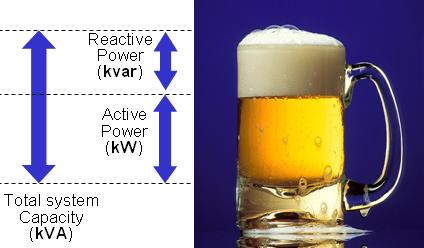
to be read with moderation…
Jacques Schonek
what a refreshing way to explain it. Thanks a lot, Jacques !
As an electrical engineer, this is the best explanation I’ve ever heard.
And a better way to appreciate beer!!!
nice illustration. it is very easy to understand
Amazing! I will use it for internal communication presentation now!
nice post,
http://mypq.epri.com/tools/correction.asp
Very simple yet easy to understand. Explains even elementary students can understand. “ACTIVE POWER” is only the same as “REAL POWER.” FYI only.
this is the best logical explanation i have ever heard about power factor
Exellent example.i will use this same example for my future presentations.lot of thanks..
Simply superb, a creative way of explaining it, i’ll definitely use this illustration in my interviews in future… thanks
Very nice example of Beer is given to understand Active & Reactive Power for Electrical Maintenance Team
Most of the website explaining in a same way and I guest, this is the best way to describe the Reactive Power.
thank you everyone for all these comments !
* these are for Jacques Schoneck our author of the month, see our 1st newsletter …
* as you can see common target is quality of our articles & comments and i recommand that you could also either share your experience by writing an article or at least subscribe to our Electrical Engineering blog (see “subscribe to the newsletter” button top right end of the blog
see you very soon
the moderator
Illustration is so easy and and nice that every one can understand.
just best
This illustration is real educative and simple to get the concept of power in electrical engineering. it can be easily understood by any class of people. Bravo to Jacques.
this is the best one for everybody.
There are no words for tstimonial of example.Jacques live 100 & 100 years to give us such examples
it is a different kind of presentation…nice, i liked it!!!
..a good visual aid, it’s always helpful! Thanks.
easiest way to understand the difference between active & reactive power
nice explanation…everyone can understand easily..
who donot hv electrical knowledge also……thank u
Super! Its way to understand everyone easily. I need to know KVA calculation.
This is one of good lesson with great example
This is interesting,I believe it requires no further explanation,even to a primary school child!
Superb Explanation……….. No Need of any traditional explanations
Reactive power is the energy that is transmitted from the generator to the load and is then returned to the generator every half cycle. It is not the froth on the beer , it is real beer, it is just that it is left in the glass. An appliance that consists of a magnetic circuit requires a certain energy to magnetise and de-magnetise the magnetic circuit in each half cycle. That energy is stored in the magnetic circuit but not converted in another form of energy. When the direction of the voltage in the circuit is reversed, the next half cycle, the energy is returned to the generator and then returned back to the load in the opposite direction to magnetise the circuit in the opposite direction. And so the cycle continues.
The reactive power (energy) is therefore not less real that the power that is being converted into another form of energy (mechanical power etc) it is just power that does not get use by the load.
David C: I think the example is spot on. However, I think our disagreement is how you apparently rate your beer. I submit that the froth is a necessary and vital part of any brew; just like reactive power is to apparent power.
Great explanation. The foam in the beer comparison is ace!
I have to agree with David C. Reactive power is every bit as important. However your illustration is amusing and does help people to understand the two types of energy.
Gail
k its very good explantation ,but i cant come to point that tell me if a gernator produce 10 mw how u will differ active apperent and reactive power plz give me a proper explanations
Innovative way of explanation….
What a way…….! I understood it very easily……..
Using a glass of beer with a head of froth to illustrate summation of active power, reactive power and total kVA is incorrect. The summation must be done vectorially using Pythagoras’ theorem. A more appropriate example is to consider the operation of a wheelbarrow. You have to first lift the handle, this is the reactive power and then pus, this is the active or real power. The total power is the hypotenuse.
De regula, sunt locuri de consum unde grosimea stratului de bere se plateste, uneori si la un pret triplat. Calitatea unei beri conforme rezulta cand stratul de spuma este gratuit. Numai atunci poti consuma cate bere vrei fara sa tedoara capul!
Usually, there are places where the thickness of beer consumption is paid, sometimes tripled in price. Achieve consistent quality beers when the foam layer is free.
Only then you can consume many beers you want without headaches.